
Ask your database
ChatPlotDB is an analyst that talks to your database. Connect Postgres, MySQL or DynamoDB, or drop in a CSV or spreadsheet, then ask in plain English. It writes the SQL, runs it, and charts the answer, with the query there to read. When a metric is ambiguous it asks instead of guessing, and it checks its own results for silent errors before it replies.
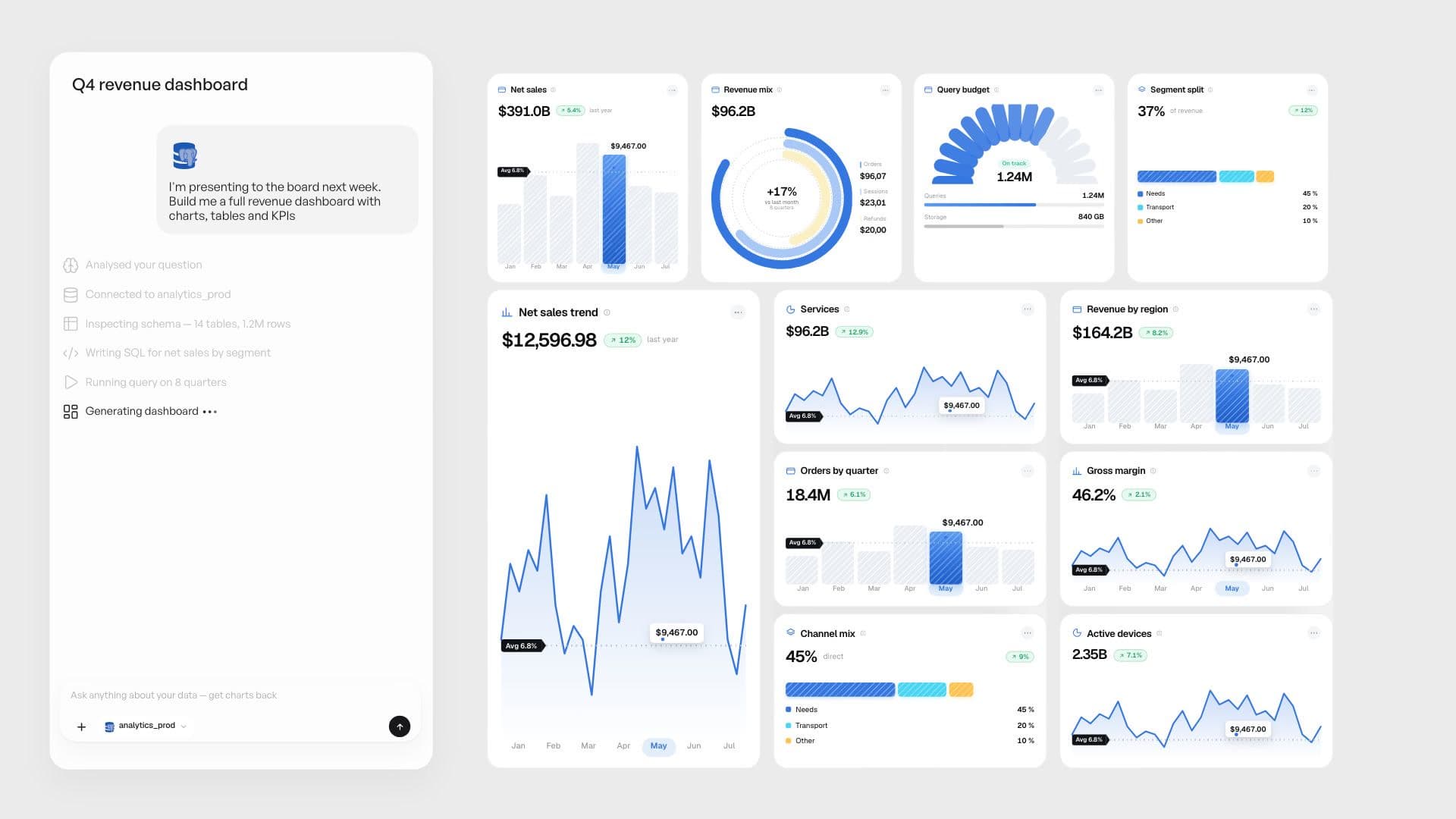
Businessteamscan’tquerydatabases.Engineersdon’tknowthebusinesscontext.ChatPlotDBbridgesthatgap,noSQLrequired.
Connections
Stitch your databases and query them in one thread
Market data in one Postgres, fundamentals in another, holdings in a third. ChatPlotDB composes up to five connections into a single stitched database, then answers one question across all of them, no exports, no joining spreadsheets by hand, no SQL.
Postgres, MySQL, DynamoDB
Connect the databases you already run. Credentials are encrypted at rest, every connection gets its own config, and you can test one before anybody chats against it.
Join keys you approved, not guessed
Config Studio introspects each database with you and verifies the keys that link them, so a cross-database answer rests on joins you signed off on rather than ones a model invented.
Only the schema it needs
On a stitched thread the agent loads a child database’s full schema only once it picks that database, so answers stay fast and precise as you add more sources.
Answers
Every answer comes back checked, charted, and with the SQL
A confidently wrong number is worse than no number. ChatPlotDB pins the metric down before it computes, verifies the result after, picks the chart the question calls for, and leaves the query beside the answer for anyone who wants to read it.
What would you like to know?
Asks before it guesses
When a question names a metric the config doesn't pin down, ChatPlotDB asks which one you mean rather than picking a column and calling it revenue.
Checks its own work
After the query runs, a verification pass looks for silent failures: an aggregate over an empty set, a join that quietly dropped rows, a filter that matched nothing. A result that fails is flagged, not presented as fact.
Charts the answer, not just the rows
The form follows the question, so “how did this change” comes back a line and “which was biggest” comes back bars. Every figure is interactive, and saves to a dashboard with the query that reproduces it.
Read more about ChatPlotDB

Why a prompt rule is not a guarantee
A system prompt rule is a request your agent can decline in silence — and what actually binds it.
Learn moreA technical deep-dive
Learn more about ChatPlotDB’s technical architecture and the engineering choices we’ve made.
Learn moreJoining two databases, without an engineer
Three honest ways to answer a question that spans two databases — and what to check before you trust the number.
Learn moreDrop in all your files,get a database on the fly
Dump in a whole folder of CSVs and Excel workbooks at once. ChatPlotDB reads every file, types every column, and stands up a database out of them on the spot, so a single question can span the lot. No schema to define, no import step, no waiting on data engineering.
What would you like to know?
FAQs
ChatPlotDB is an AI data analyst for your own databases. You connect a data source, ask a question the way you'd ask a colleague, and it plans the query, writes the SQL, runs it, and hands back an interactive table or a chart, with the SQL visible the whole time.
It is built for the people who understand the business but don't write SQL: operations, support, finance, founders. No query to write, no ticket to the data team, no waiting.
PostgreSQL and MySQL with credentials encrypted at rest and SSL modes supported, Amazon DynamoDB with items flattened into queryable tables, and CSV or Excel files uploaded and queried directly with no setup at all.
A single conversation can also span several sources at once: a stitched config composes between two and five databases so one question can reach across them.
No. You ask in plain English and ChatPlotDB writes the SQL for you. The generated query is always shown, so anyone who does read SQL can check the logic, and anyone who doesn't can ignore it entirely.
If a metric you name is ambiguous, the agent asks a clarifying question before it queries anything, rather than guessing and returning a confident wrong number.
No. It only ever issues read queries. The recommended setup goes further: connect it with a database role that has SELECT on the tables you want queried and nothing else, so the credential itself cannot modify anything.
The SQL that produced each answer is shown alongside it, so anyone who reads SQL can check exactly what ran.
A text-to-SQL box turns one sentence into one query and hopes for the best. Between your question and the answer, ChatPlotDB puts a configuration layer that knows which tables matter, how they join, and what your team's words mean, so "active account" resolves to the same thing every time, for everyone.
That layer is the difference between a demo that works on a clean schema and something a team can rely on against a real one.
Six models, from four providers: OpenAI's GPT-6.1 Sol is the chat default, with GPT-6 Luna alongside it, Z.ai's GLM-5.3 Flash and DeepSeek V4.1 Flash are the fast, low-cost pair, and Anthropic's Claude Opus 5.5 and Sonnet 5.5 handle the hardest reasoning. You pick per conversation, and if a provider has a problem the request moves to another one so you still get an answer.
On the managed service, model calls go to each vendor's API. On an enterprise deployment they don't leave your cloud: ChatPlotDB runs in your own AWS account and serves those same models through Amazon Bedrock, in the region you choose.
Yes. The Slack app answers data questions in the channel where the question came up and posts the table or chart straight back into the thread, so the numbers land next to the conversation that needed them rather than in a tool nobody opens.
Answers you want to keep can be saved to a dashboard as cards, refreshed on a schedule, and set to ping Slack when a number crosses a threshold you define.